The suggested figures for The Africans taken from "TheTreasures of Terpsichore; OR,
A COMPANION FOR THE BALL-ROOM. BEING A COLLECTION OF ALL THE
MOST POPULAR ENGLISH COUNTRY DANCES, Arranged Alphabetically, with proper Figures to each Dance. BY T. WILSON, DANCING MASTER, from the King's Theatre, Opera House, AND AUTHOR OF 'THE ANALYSIS OF COUNTRY DANCING.'
Africans (The). 2 PARTS REPEATED.
Single Figure.
Set and change sides, down the middle, up again, right and left.
Or thus:
Hey of your own sides, cross over two couple. and lead up one.
During the Napoleonic Wars, the Cape Colony was annexed by the British and officially became their colony in 1815 and this may possibly have inspired the title.
Thursday, 16 April 2015

Saturday, 4 April 2015
Two Bath dances from 1797
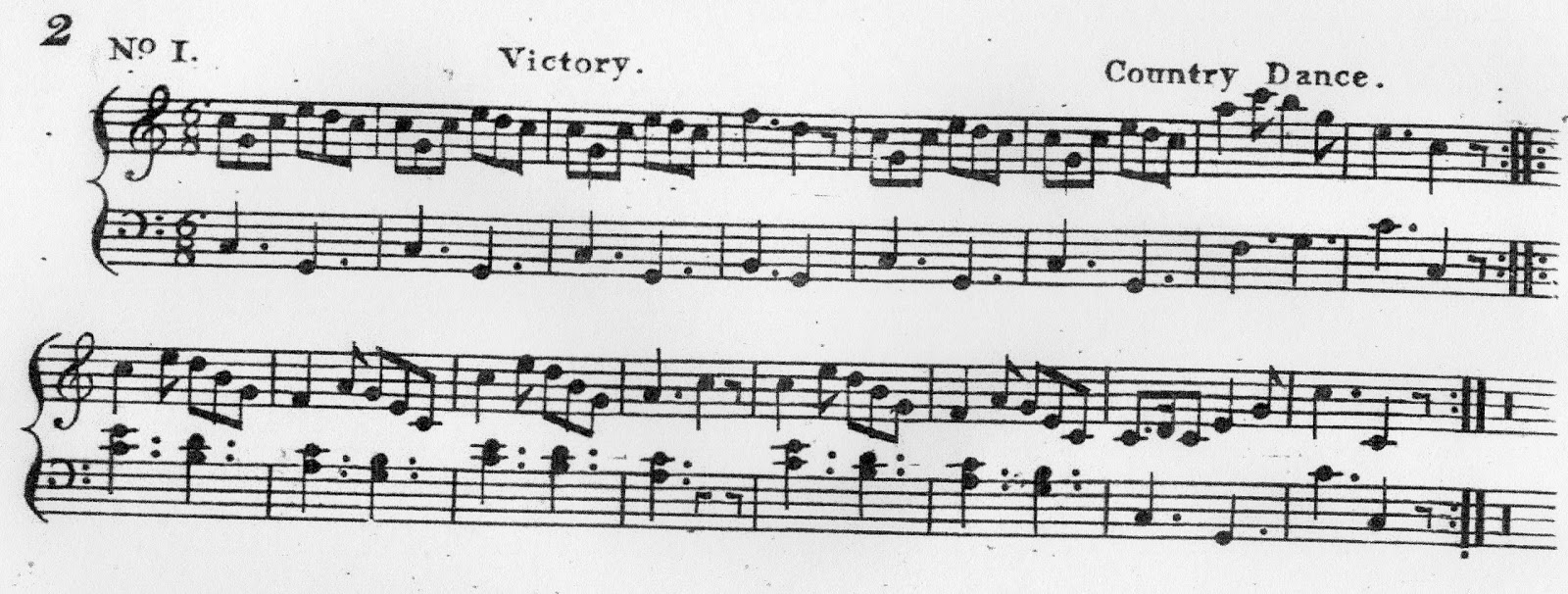
The originally suggested figures for the country dance tune Victory. Taken from "Ten Country Dances and four cotillions with their basses for the pianoforte as they are now danced at Bath for the year 1797. Price 1s 6d. Printed for & sold at J&W Lintern's Music Warehouse, Abbey Church Yard Bath."
First and second Cu. set and Hands across ~ Same Back again ~ Lead down the,
Middle and up again ~ Right and left at Top 8 ~
From the same book come suggested figures for the country dance tune, The Whimsical Lover.
First & 2d. Cu ~ set & change Sides - The same Back again - Lead down the Middle & up again ~ Right & Left at Top ~
Lintern, J. & W. Abbey Church Yard were music sellers, publishers and agents for the long-established London publishers Longman, Clementi & Co. and Cahusac & Sons at the sign of the "Two Flutes and Violin, opposite St Clement's Church in the Strand,"

The title "Victory" may well be inspired by the Battle of Cape St. Vincent (14 February 1797), where a British fleet under Admiral Sir John Jervis defeated a larger Spanish fleet under Admiral Don José de Córdoba y Ramos near Cape St. Vincent, Portugal.


First and second Cu. set and Hands across ~ Same Back again ~ Lead down the,
Middle and up again ~ Right and left at Top 8 ~
From the same book come suggested figures for the country dance tune, The Whimsical Lover.
First & 2d. Cu ~ set & change Sides - The same Back again - Lead down the Middle & up again ~ Right & Left at Top ~
Lintern, J. & W. Abbey Church Yard were music sellers, publishers and agents for the long-established London publishers Longman, Clementi & Co. and Cahusac & Sons at the sign of the "Two Flutes and Violin, opposite St Clement's Church in the Strand,"


Thursday, 2 April 2015
Lady Archer, make-up and gambling

In the latter part of the eighteenth century, a number of aristocratic ladies opened their houses for gambling, one of the best known, probably, being Lady Archer. It is the lady whose toilet regime is immortalised in this 1792 print by Thomas Rowlandson when she was 51. Lady Archer's commitment to "beauty" can also be judged from the following extracts from the Morning Post.
"Jan. 5, 1789. The Lady Archer, whose death was announced in this paper of Saturday, is not the celebrated character whose cosmetic powers have long been held in public estimation."
"Jan. 8,1789. It is said that the dealers in Carmine and dead white, as well as the perfumers in general, have it in contemplation to present an Address to Lady Archer, in gratitude for her not having DIED according to a late alarming report."
 |
| The Exaltation of Faro's Daughters by James Gilray depicting Lady Archer and Lady Buckingham |
Lady Archer's gambling business featured the card game Faro. Indeed, she and her "sisters" were satirised as Faro's daughters. Faro houses were notorious for bilking their customers. Indeed, the odds of the game (see below) are such that the house could only ensure profits by cheating in some form or other.
The sort of money that could be made from this game by Faro house operators can be illustrated by a court case reported by the Bath newspapers in 1787.
Gambling was always central to the entertainment that attracted the Ton to Bath, and repeated attempts by the law to regulate it failed in the face of the Georgian obsession with gaming and the large amounts of money to be made by catering to this obsession.
As the Bath Chronicle of 12th April 1787 reported:
"Yesterday Mr. John Twycross and Mr Richard Weternall were convicted before the Mayor, on several counts, of keeping a Faro and other Gambling Table and sentenced to pay, Twycross four hundred, and Wettenall fourteen hundred pounds"
The article goes on to say:
"Eighteen hundred pounds [approximately the equivalent £100,000 today] is a seemingly large sum; but when the various arts of seduction to support this Faro Table, and its immense profits, are considered, it will appear a mere trifle. Every allurement of expensive eating and the richest wines are ever speciously ready, to invite the convivial. The hounds are principally, if not solely, supported to take in country gentlemen; and the present culprits are only the ostensible members of a numerous co-partnership, amongst whom the money may be easily raised; and who, like the Syrens of old, are unceasingly employed to draw devoted victims into this dreadful vortex of destruction."
Twycross and Wetenall ran their rooms in Alfred Street, which runs alongside the Upper Assembly Rooms and were therefore well placed to exploit the well-heeled crowds attracted there in the season.
The game of Faro originated at the court of Louis XIV. The game quickly spread to England. Because it is relatively easy for the banker to rig the cards, Faro became very popular with the proprietors of gaming houses.
Faro is a game of pure chance played on a baize table with a board of 13 cards enamelled into it and used to place bets. These cards are traditionally spades, but it is the rank of the card that matters in the game, not the suit. One player is selected as the banker, as with all games of pure chance, even an honest banker enjoys a considerable advantage. The role of the banker was usually decided by auction or fixed by the house. Players bet on which rank will win or lose the next round. A shuffled deck of 52 cards is then dealt from a specially designed box. The first card revealed by the bank is called the soda and is placed to the left of the banker, playing no role in the game. The second card, placed to the right of the banker, is the losing card. The third card placed on top of the soda is the winning card. The game continued until there were just three cards left in the box, at which point the players bet on the order in which they would appear. The players knew which cards remained because the banker used a device known as a casekeeper to record the cards that had been dealt.
Wednesday, 25 March 2015
The rooms and the racing crowd
The horse racing which took place on Claverton Down attracted sizable crowds and enormously wealthy owners and gamblers.
Many businesses in Bath sought to profit from this, and the Assembly Rooms were no different. So, when, in 1772, there was a three-day meeting in September, the Upper Rooms put on a pre-season ball, as described in this advertisement in the Bath Chronicle.

There were also Balls at Gyde's Lower Rooms on Tuesday and Thursday Nights at the same price.
The racing took place from September 21st through to Thursday, the 24th, on Claverton Down.
Those owners of horse raced included:
The enormously wealthy gambler, horse breeder and pimp Denis O'Kelly.
Sir Richard Bamfylde MP for Exeter.
Mr Wildman was a very wealthy meat wholesaler.
Edmund Boyle, 8th Earl of Cork
John Parker of Saltram House in Devon. A close friend of the Prince of Wales
Many businesses in Bath sought to profit from this, and the Assembly Rooms were no different. So, when, in 1772, there was a three-day meeting in September, the Upper Rooms put on a pre-season ball, as described in this advertisement in the Bath Chronicle.
There were also Balls at Gyde's Lower Rooms on Tuesday and Thursday Nights at the same price.
The racing took place from September 21st through to Thursday, the 24th, on Claverton Down.
Those owners of horse raced included:
The enormously wealthy gambler, horse breeder and pimp Denis O'Kelly.
Sir Richard Bamfylde MP for Exeter.
 |
| Lady Bampfylde by Sir Joshua Reynolds, c.1776 |
Edmund Boyle, 8th Earl of Cork
John Parker of Saltram House in Devon. A close friend of the Prince of Wales
Wednesday, 18 March 2015
Beauchamp notation
 |
| Lady's Track |
 |
| A Step with the Right Foot |
The king's command provoked a race among dancing masters to devise such a system, but Beauchamp prevailed and, after years of work, presented the King with five volumes of symbols with explanatory notes and complete notated dances. Beauchamp failed to obtain the required permissions to publish his work.
 |
| Gentleman's track |
 |
| A Slide |
Because of Beauchamp and Feuillet's work, we now have more than 300 fully notated dances from the 17th and 18th centuries available to dance today.
In 1706, the English Dancing Master published Orchesography, the first English Feuillet’s Chorégraphie. Weaver's introduction to an English-speaking audience of the Beauchamp-Feuillet notation enabled more widespread communication of dance compositions and promoted a uniform set of standards in dance throughout England. A Small Treatise of Time and Cadence in Dancing (1706) expanded the musical section in Orchesography. In An Essay Towards a History of Dancing (1712), Weaver drew from diverse sources to document the history of dance from its ancient traditions to the 18th century and argued for dance’s importance as a means of expression and a sign of social accomplishment. Weaver also wrote about the physical aspects of dance in Anatomical and Mechanical Lectures upon Dancing (1721), in which he emphasized the need to understand human anatomy to use the body as a tool of expression. Weaver’s contributions helped to establish dance in England as a narrative form and a respected method of artistic expression.

Monday, 9 March 2015
Masked balls much more than masks
In the 15th June 1769 edition of the Bath Chronicle the following description of the previous week's masked ball thrown by the Duke of Bolton on his estate at Hackwood near Basingstoke.

'The company began to assemble between seven and eight, and by ten o'clock, the rooms were very full of masks. About twelve, five different apartments were opened, in which the most elegant and beautiful sideboards were prepared, the illuminations at which were prettily conceived and finely executed; as were also a lighted temple and some other buildings in the gardens.
 |
| Lady Gideon |
 |
| Mrs Garrick with her husband |
 |
| Lady Waldegrave |
 |
| Mrs Ruben and family |
The following is taken from a letter of 1772 describing a masked ball in Southampton.
"The masked ball, on Thursday last, was not so numerous as a former one about two years ago; however, the characters were in general well supported, particularly that of a Devil, who, on entering the room, welcomed the company to his infernal regions, and expressed his joy at seeing so many of his true and faithful servants in all places; a very good Mother Shipton [ a medieval soothsayer and prophetess]; a Dutch Pedlar; a Tancred [a Norman leader of the First Crusade], tolerably well supported; a Running Footman; some Jews, Turks, and Persians, richly dressed; a magnificent Nabob; two very witty Haymakers, who exited the attention of all the beaux; several Shepherds and Shepherdesses; a Milk-maid and her companion, who did not unmask the whole evening."
It is instructive to compare this with Fanny Burney's fictional description of a masquerade in her novel Cecilia which she started writing in 1780, a year in which she came to stay in Bath with Hester Thrale. The story is told from the point of view of the heroine, who is attending a masquerade for the first time.
'Soon after nine o'clock every room was occupied, and the common crowd of regular masqueraders were dispersed through the various apartments. Dominos [sic] of no character, and fancy dresses of no meaning, made, as is usual at such meetings, the general herd of the company, for the rest, the men were Spaniards, chimney sweepers, Turks, watchmen, conjurers, and old women; and the ladies, shepherdesses, orange girls, Circassians, gipseys [sic], haymakers, and sultanas.
Cecilia had, as yet, escaped any address beyond the customary enquiry of Do you know me? and a few passing compliments; but when the rooms filled and the general crowd gave general courage, she was attacked in a manner more pointed and singular.
The very first mask who approached her seemed to have nothing less in view than preventing the approach of every other; yet had little reason to hope favour for himself, as the person he represented, of all others least alluring to the view, was the devil! He was black from head to foot, save that two red horns seemed to issue from his forehead; his face was completely covered that the sight only of his eyes was visible, his feet were cloven, and in his right hand. he held a wand of colour of fire."
In the Bath Chronicle on January 8th 1801, we hear of Mrs Champneys’ [sic] Masquerade
"Wednesday an elegant suite of apartments were thrown open at Orchardleigh-house [the Champney's ancestral home between Bath and Frome] for the reception of masks, who, to the number of 200, assembled at an early hour. In order to heighten the hilarity of the entertainment, all dominoes were excluded; the characters were numerous, and these, by their frequent change of dress , added apparently to the catalogue of merry mortals. Among the most popular, a jessery wild goose in search of his daughter, an owl, a lame fiddler, Punch, a most beautiful figure in the dress of a Christ’s Hospital Boy, a Fury clothed in the terrors of infernal paraphernalia pursuing an Orestes, two chattering Barbers, a dancing bear, a pretty milk maid, an elegant representative of a fille de patmos, and a French taylor bien habille galloping on a very
 |
| A Fille de Patmos 1700 magnificent goose. This last mask, was exquisite, and by the drollery of its appearance, and the novelty of its accoutrements, preserved its fascination throughout the whole of the diversion. There were a few elegant figures of both sexes, very splendidly dressed, and although the parade and insipidity of finery is inconsistent with the true genius of a masquerade, yet even this is less offensive than noisy nonsense and impertinent clamour. The supper was served in the richest profusion; but from a laudable attention to the severity of “existing circumstances” the use of bread was entirely prohibited." |
 |
| A masquerade, circa 1808. |
Wednesday, 4 March 2015
According to the Stranger's Assistant and Guide to Bath of 1773
The Public Balls are two in each week during the season, one on Monday, at the New Rooms on the East Side of the Circus, the other on Friday, at Mr. Gyde's Rooms on the Walks, lately kept by Mr. Simpson. The subscription to each is one guinea for the season, for which the subscriber is entitled to three tickets. Each Lady and Gentleman on a ball night pays six-pence on their admission, which entitles them to tea.
The modern income equivalent of a season's subscription would be about £2000 and ball night admission about £60.
The following Rules were published by the Master of the Ceremonies for the regulation of the balls of Bath:
It being absolutely necessary that a propriety of dress should be observed at so polite an assembly as that of Bath, it is humbly requested of the company to comply with the following regulations:
That Ladies who dance minuets be dressed in a suit of clothes or a full-trimm'd sack, with lappets and dress'd hoops, such are usually worn at St. James's.
It is requested of those Ladies, who do not dance minuets, not to take up the front seats at the balls.
That no Lady dance country dances in a hoop of any kind; and those who chuse [sic] to pull their hoops off, will be assisted by proper servants in an apartment for that purpose.
That no Lady of Precedence has a right to take place in country dances after they have begun.
The places at the top of the room are reserved for Ladies of Precedence, of the rank of Peeress of Great-Britain or Ireland; it being found very-inconvenient to have seats called for, and placed before the company after the ball has been begun.
That Gentlemen who dance minuets do wear a full-trimmed suit of clothes, or French frock, hair or wig dressed with a bag.
Officers in the navy or army in their uniforms, are desired to wear their hair or wig en queue.
Ladies are not to appear with hats, nor Gentlemen with boots, in an evening after the balls are begun for the season; nor the Gentlemen with spurs at the Pump-Room in a morning.
The Subscription Balls will begin as soon as possible after six o'clock, and finish precisely at eleven, even in the middle of a dance.
That no hazard, or unlawful games, will be allowed in these Rooms, on any account whatsoever, and no cards on Sundays.
This relates only to the New Rooms.
That in case any subscriber to the balls should leave Bath before the season is over, such subscriber may, by leaving an order under their hand, transfer his or her tickets for the remaining part of the season.
W. Wade, M. C.
Besides the public balls, before mentioned, there are others of a more private nature (whose tickets admit only the Subscribers) called Cotillon [sic] balls, which are held twice a week, viz., at Mr. Gyde's on Tuesday, and at the New Rooms on Thursday. The Subscription is half a guinea for the season, or as long as the subscription will hold out, for which tea is allowed.
The New Assembly-Rooms and Mr Gyde's Rooms are both open for walking in and playing at cards, each night in the week, except Sundays, when cards are not allowed, and Fridays, when the New Rooms are shut up. There are likewise two public card nights in the week, viz., on Tuesday at the New Rooms, and on Friday at Mr. Gyde's Room. On Sundays, there is a public Tea-drinking at each of the Rooms, to which every person is admitted, on paying sixpence. The subscription for walking in the Rooms for the season is ten shillings to each set of Rooms for the Gentlemen and five shillings for the Ladies. The subscription to Mr. Gyde's Room gives the subscriber admission to the walk by the riverside, formerly well known by the name of Simpson's Walk. There are two Concerts each week during the season; one at the New Rooms, and one at Mr. Gyde's. The subscription to which is one guinea for the Gentlemen, and half a guinea for the Ladies. The concert at the New Rooms is on Wednesday evening, and that at Mr. Gyde's on Tuesday, but these sometimes vary. The Theatre is situated in Orchard Street, and is the property of Mr. John Palmer, the Patentee. The days of performance are Tuesdays, Thursdays, and Saturdays. During the spring and summer seasons, a public garden, called Spring-Gardens, belonging to Mr. Purdie, and situated nearly opposite the Grove, across the River Avon, is open for walking in: The subscription is half-a-crown for the season.
The modern income equivalent of a season's subscription would be about £2000 and ball night admission about £60.
The following Rules were published by the Master of the Ceremonies for the regulation of the balls of Bath:
It being absolutely necessary that a propriety of dress should be observed at so polite an assembly as that of Bath, it is humbly requested of the company to comply with the following regulations:
That Ladies who dance minuets be dressed in a suit of clothes or a full-trimm'd sack, with lappets and dress'd hoops, such are usually worn at St. James's.
It is requested of those Ladies, who do not dance minuets, not to take up the front seats at the balls.
That no Lady dance country dances in a hoop of any kind; and those who chuse [sic] to pull their hoops off, will be assisted by proper servants in an apartment for that purpose.
That no Lady of Precedence has a right to take place in country dances after they have begun.
The places at the top of the room are reserved for Ladies of Precedence, of the rank of Peeress of Great-Britain or Ireland; it being found very-inconvenient to have seats called for, and placed before the company after the ball has been begun.
That Gentlemen who dance minuets do wear a full-trimmed suit of clothes, or French frock, hair or wig dressed with a bag.
Officers in the navy or army in their uniforms, are desired to wear their hair or wig en queue.
Ladies are not to appear with hats, nor Gentlemen with boots, in an evening after the balls are begun for the season; nor the Gentlemen with spurs at the Pump-Room in a morning.
The Subscription Balls will begin as soon as possible after six o'clock, and finish precisely at eleven, even in the middle of a dance.
That no hazard, or unlawful games, will be allowed in these Rooms, on any account whatsoever, and no cards on Sundays.
This relates only to the New Rooms.
That in case any subscriber to the balls should leave Bath before the season is over, such subscriber may, by leaving an order under their hand, transfer his or her tickets for the remaining part of the season.
W. Wade, M. C.
 |
| Mr Wade |
Besides the public balls, before mentioned, there are others of a more private nature (whose tickets admit only the Subscribers) called Cotillon [sic] balls, which are held twice a week, viz., at Mr. Gyde's on Tuesday, and at the New Rooms on Thursday. The Subscription is half a guinea for the season, or as long as the subscription will hold out, for which tea is allowed.
The New Assembly-Rooms and Mr Gyde's Rooms are both open for walking in and playing at cards, each night in the week, except Sundays, when cards are not allowed, and Fridays, when the New Rooms are shut up. There are likewise two public card nights in the week, viz., on Tuesday at the New Rooms, and on Friday at Mr. Gyde's Room. On Sundays, there is a public Tea-drinking at each of the Rooms, to which every person is admitted, on paying sixpence. The subscription for walking in the Rooms for the season is ten shillings to each set of Rooms for the Gentlemen and five shillings for the Ladies. The subscription to Mr. Gyde's Room gives the subscriber admission to the walk by the riverside, formerly well known by the name of Simpson's Walk. There are two Concerts each week during the season; one at the New Rooms, and one at Mr. Gyde's. The subscription to which is one guinea for the Gentlemen, and half a guinea for the Ladies. The concert at the New Rooms is on Wednesday evening, and that at Mr. Gyde's on Tuesday, but these sometimes vary. The Theatre is situated in Orchard Street, and is the property of Mr. John Palmer, the Patentee. The days of performance are Tuesdays, Thursdays, and Saturdays. During the spring and summer seasons, a public garden, called Spring-Gardens, belonging to Mr. Purdie, and situated nearly opposite the Grove, across the River Avon, is open for walking in: The subscription is half-a-crown for the season.
Subscribe to:
Posts (Atom)