Showing posts with label 2025. Show all posts

Saturday, 24 June 2023

Round Top and Bottom Couples


This diagram is taken from Thomas Wilson's "English Country Dancing", published in 1820.

Wilson describes this as one of the many "new" figures he is introducing to country dancing.


Sunday, 14 May 2023

Hoops


Bath Chronicle and Weekly Gazette - Thursday 19 September 1765

'Ther will be a ball as usual at Mr Simpson's Rooms on Monday next, being the anniversary of their Majestyies [sic] Coronation; subscribers of which are taken in at both Rooms No Ladies to be admitted to dance a minuet, without a lappetted head and full dress hoop; and such minuet dancers as chuse [sic] to dance country-dances must be attended by a woman servant to put the hoops off, as no hoops (be their size large or small) are allowed in country dances.'

The sheer size of hoops made them a problem when moving around, and carriages and doorways had to be modified; even then, women often had to enter rooms sideways; small rails were put in place around tables to stem the risk of small objects being swept off the top by entrant hooped skirts. For this reason, they were increasingly not permitted in country dances which at the Assemblies meant large numbers dancing in close proximity. At one court ball in 1780, the ladies were said to have worn such large hoops that they took up as much room as four people[1]. Mr Neal, the treasurer of the Charitable Musical Society of Dublin, made it a proviso for attendees at his new music hall that women remove the hoops from their skirts and men remove their swords so that 700 people could be squashed in.


  1. Peg Plunkett: Memoirs of a Whore by Julie Peakman

Wednesday, 1 February 2023

Two Dances from 1795


Published by Cahusacs: Thomas Cahusac, Sr., and his two sons, Thomas, Jr., and William Maurice, were instrument makers in London during the late eighteenth and early nineteenth centuries.

Sunday, 6 November 2022

Racing Women

In 1748, the Bath Journal of August 8:

‘Advertisement, the following ASSES were entered to run on the Town-Common Thursday last; the Names they were enter’d by were, Merry Pintle, Spanking, Roger, Morecock, Turpin, Mouse, Perrdy, Spider, Picksey, Pug, Jan Parsons, Roger &c. They were rode by Boys, and the Plate was won by Jackey Skares’ Ass Merry Pintle - There were Six Thousand Persons on the course, and some of Distinction who came many miles to see the Sport - a Smock and Hat were run for at the same Time by Girls.’

There are a couple of things of interest here; firstly, how popular ass racing was and how well-known many of the asses were. The second is that it is an early Bath reference to the popular Georgian Sport of smock racing. It probably also tells you something about contemporary attitudes toward working-class women: the Asses were the main attraction and were named.

Another advert for a similar event featuring asses and girls provides further information. The Smock race would consist of three heats; the winner would receive the smock, the second would receive the hat, and the third would receive half a crown, which gives some idea of the considerable value of the clothing. Women who wished to compete were required to report to the Common-house by 3 p.m. on the day. The asses won a guinea for first, 5 shillings for second and half a crown for third. 

Smocks or shifts were the essential all-purpose undergarment for Georgian women, worn beneath stays and gowns during the day and often also in bed at night. The smocks offered as prizes were typically made of high-quality linen and frequently featured lace and ribbons for trimming. The prize smock was often displayed hanging from a nearby flagpole or tree branch. 

Rowlandson 1811


Smock races wera e populaform of r entertainment throughout the Georgian period, partly because thecatered toed the almost insatiable demand for gambling opportunities, but also, and perhaps primarily, because theprovided male spectators withor thopportunityrs to see young women wearing loose clothing, which often became disarranged and flushed from physical exertion. This is amply illustrated in the above Rowlandson print.

From all the reports and the many prints, competition among the often desperately poor women was fierce. There do not seem to have been any actual rules, and the women freely tripped and barged over their rivals, often knocking them into the dust. The more violent the race became, the louder the audience would roar, and the more acclaim the eventual victor would receive.

Smock races took place in various locations around Bath throughout the eighteenth century, including the Parades and Lansdown and were a feature of many fairs.


Borsay, P. (2000). The image of Georgian Bath, 1700–2000: Towns, heritage, and history. Oxford University Press.

Bath Journal. (1748, AAugust 8. Advertisement.

Rowlandson, T. (181August 8ck race illustration].


Wednesday, 3 August 2022

First well documented race meetings in Bath


William Capell
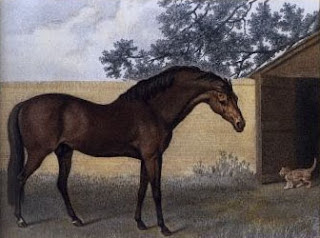
John Cheny (1727–1750), in his racing calendar, carries details of the first well-documented race meeting in Bath on the 25th of September 1728. The meeting took place on Claverton Down when William Capell, 3rd Earl of Essex's horse Smiling Ball, beat three other horses over three four-mile heats, coming first in all of them for a prize of 50 guineas.

Smiling Ball, we learn from "The Turf Register and Sportsman & Breeder's Stud-book" by William Pick, had been bred by Mr Gaze of Lincolnshire and sold to the Earl of Essex.

Smiling Ball's sire was bred by Sir Matthew Peirson, Bart and got by Old Merlin out of a dam bred by Mr Curwen, got by his Bay Barb; grandam by the Curwen Old Spot, out of a daughter of Lord D'Arcy's Woodcock.

At Newmarket, in April 1728, Smiling Ball, carrying 9st, beat Lord Gower's Miss Wilkins, carrying 8st 7lb over four miles for a prize of 200gs. Incredibly, only three hours after that race, and carrying 7st, he beat Lord Hallifax's Partner, by Jigg, carrying 9st over a four-mile course, thus winning the Earl another 200gs.

He won 80gs at Stamford, beating Mr Bertie's Ladythigh; walked over for 50gs at Oxford; his next race was the meeting at Bath,

After Bath, he went north and won the Gold Cup, value 50gs at Warwick, beating Mr Cole's Singlepeeper and Mr Howe's Lampire.

So, in a single year, he won his owner 710gs, worth approximately £65,000 at today's values. This, of course, does not include his Lordship's winnings at the betting post.

In 1729, he won £50 carrying 10st at Guilford, beating Lord Onslow's Singlepeeper and Mr Bennet's Bumper. He then won another Gold Cup, valued at 50gs at Andover and £30 at Grantham, beating Mr Heneage's Whitenose and three others; 40gs at Leicester; and 10gs at Epsom.

At stud, he sired several notable horses, including Mr Mewburn's Smiling Ball, Sir Harry Harpur's Darling, Mr Shaw's Ploughman, Mr Barker's Venture, Mr Arundale's Fancy, Lord March's Roderick Random, and several others. 

The other horses in the race were:

Mr Kirby's Black Horse Collier
Rev. Mr Thorpe's Chestnut gelding Frostyface

In Bath, we have another record of racing on the 1st and 2nd November 1728 featuring two races, one for six horses over three four-mile heats for 20 guineas won by Mr Longton's unnamed grey horse. The second race was for Galloway's and was won by Mr Proctor's grey mare Northern-Nancy.

Friday, 1 July 2022

Bath Races 1757

"It is thought there will be good Sport at our Races several horses are already here and many more are daily expected" Bath Journal September 1757.

The 1757 meeting started on Wednesday the 5th of October 1757 on Claverton Down with a race for a purse of fifty pounds for any horse, mare or gelding, that had not won the value of fifty pounds (matches excepted); five-year-olds to carry eight stone seven pounds; six year olds nine stone seven pounds; aged ten stone seven pounds bridle and saddle included; best of three-four mile heats.

Five horses were entered ahead of time:

  • Mr Smart’s Grey mare Grey of Greys Five years old
  • Mr Moore’s Chestnut horse Six years old
  • Mr Butler’s Grey Horse Sterling, Six years old
  • Mr Parham’s Bay horse Vortigern Aged

On the day, Lord Bruce entered his horse Fox at the post

Lord Bruce

This is almost certainly Thomas Brudenell-Bruce, 1st Earl of Ailesbury KT (30 April 1729 - 19 April 1814), styled The Honourable Thomas Brudenell until 1747 and known as Lord Bruce of Tottenham between 1747 and 1776. He subsequently served as Lord Lieutenant of Wiltshire from 1780 to 1782.[1]
.
Vortigern won the first heat but took the turn at the post too short in the second which brought down both horse and rider. Victory in the race finally went to Starling.

On Thursday the 6th on the same course, they ran for a purse of fifty pounds, for any horse, mare or gelding that has not won more than one fifty pound plate this year; five years old to carry ten stone four pounds; six years old eleven stone four pounds; aged twelve stone, bridle and saddle included; the best of three-four mile heats. Six horses were entered before the meeting:


  • Mr Scudamore’s Grey horse Sober John Six years old
  • Mr Howe’s Bay horse Mercury Five Years old
  • The Earl of Eglington’s Grey horse Gog Magog Aged
  • Mr Cornwall’s brown horse Redstreak Aged
  • Mr Roger’s Grey mare Chastity Five years old
  • Mr Jennison’s Grey horse Why not Aged
Alexander Montgomerie, 10th Earl of Eglinton, one of twenty siblings, was the eldest son of the 9th Earl of Eglinton and Susanna Montgomery, Countess of Eglinton the earl's third wife and a renowned society beauty. Alexander planned and built the conservation village of Eaglesham in 1769 around the basic plan of a capital 'A' (for Alexander). The Earl introduced the young James Boswell to the joys of London society in the early 1760s, and figures prominently in Boswells London Journal, 1762-63. He was the Grand Master Mason of the Grand Lodge of Scotland from 1750-51. We know that the Earl was present in person because the Bath Journal records his arrival sometime between September 19th and September 26th. 


There were no horses entered at the post despite pre-meeting expectations that there would be.

Mercury won the first heat and Redneck the last heat by a narrow half-length. The purse was awarded to Redneck but Mercury won the stakes as the "second bell horse."

The horses had to be shown and entered on the Saturday before the day of running, between the hours of twelve and six, at Mr Figg’s, at the Lamb Inn in Bath, and be subject to the articles produced at the time of entrance. Certificates of their qualification for each of the purses had to be produced at the time of entrance, or before the day of running no less than three reputed running horses had to start for either of these purses. Owners had to pay two guineas entrance per horse if they were subscribers to the Bath races, and five shillings to the Clerk of the Course; a non-subscriber paid three guineas and five shillings to the Clerk of the Course, or double at the post. In the event that only one horse, was entered for a race, his owner would win ten guineas for the walk-over, and his entrance money returned and if only two they would get five guineas each, and their entrance money returned. Any disputes would be settled by the gentlemen who could afford to be in the stands.

No horses were to be plated (shod) by anyone but a smith that had subscribed half a guinea to the organisers. No persons would be allowed to sell any liquor on the Down unless they had subscribed one guinea. The stakes of each day for the second bell horse, etc. The winning horse etc. of the first day not to start for the second purse.

There were back sword contests in the Market Place Tuesday before the races and on Friday after the races and the will be a Ball each night of the races in the Town Hall.

1. G.E. Cokayne; with Vicary Gibbs, H.A. Doubleday, Geoffrey H. White, Duncan Warrand and Lord Howard de Walden, editors, The Complete Peerage of England, Scotland, Ireland, Great Britain and the United Kingdom, Extant, Extinct or Dormant, new ed., 13 volumes in 14 (1910-1959; reprint in 6 volumes, Gloucester, U.K.: Alan Sutton Publishing, 2000), volume I, page 63. Hereinafter cited as The Complete Peerage.

Sunday, 13 March 2022

The Equestrian Circus in Monmouth Street and the Child of Promise

On 17th April 1788, the following advertisement appeared in the press:

'By particular Desire of several Ladies and Gentlemen positively the last night. At Ryle’s Ride, the top of Monmouth Street, will be presented a variety of equestrian exercise; consisting of horsemanship by the whole troop, tight rope dancing, by the unrivalled Signora Riccardini, and the Child of Promise. Slack Rope Vaulting by Master Smith, Mr Smallcomb will pick up a watch blindfold. Mr Handy, in the character of harlequin, will make several surprising leaps through a hogshead of real fire (Beatles fans take note), to conclude with the tailor's disaster Or disagreeable journey to Brentford, with the hunter and road horse, by Mr Smallcombe. The doors open at half past five, and begin at half past six. Front seats, 2s. Back seats, 1s. Mr Handy returns his best thanks for the great encouragement he has been honoured with in this city.'

Stephen Ryle, who put in this advertisement, kept equestrian premises in Monmouth Street from which he sold carriages and horses and ran a stud. He also offered riding tuition in his ‘Circular Riding School.' 


Benjamin Handy began his career as an ostler with Hughes Equestrian Circus. Hughes had been a performer with Phillip Astley’s famous circus in London but left to create his own company and amphitheatre with the intention to break Astley’s virtual monopoly. Handy’s appearance with his own company in Bath seems to have been one of his first. The company mostly consisted of members of his own family and former members of the company Astley had brought to Bristol in the 1770s. 

The Tailor's Disaster Or Disagreeable Ride to Brentford was a well established clowning routine which would have been familiar to those who had attended Astley's shows.

Signora Riccardini was Handy’s wife who could perform on 'One and Two Horses in a capital Manner’ and famously would stand on her head on top a spear surrounded by fireworks. She and  Benjamin had married in Birmingham in 1873.

The 'Child of Promise' was the Handy's daughter, Mary Ann, whose star turn was riding on another rider's shoulders ‘without the assistance of Hand or Rein, having nothing to keep her up but her perpendicular Balance, and which is allowed to be the greatest balance ever attempted.’ She would have been around four years old in 1788. A year later, her father refused an offer of 365 guineas a year from Astley for the services of his daughter. 

The Master Smith mentioned in the bill was Handy’s indentured apprentice; however, by the 1787 -8 season, he had run away from his service, and by 1793, he had become a major star of the London circus scene.

Astley's Amphitheatre in 1777

At Bristol on 25th April 1788, in 'a large commodious yard at the back of the Angel, in the Borough Walls, leading from Redcliff Street to Thames Street, ' a group of performers from Astley’s and Hughes’s riding schools in London were presenting riding, rope dancing and other entertainments, but the group was called (Benjamin) Handy’s Troupe in the advertisements. Featured were 'the celebrated Mr Franklin, the Child of Promise' (Mary Ann Handy), Signora Riccardini (Mrs Handy), and Benjamin Handy. Mr Franklin was Thomas Franklin the son of a clown, famous for his feats of strength.


In December 1788 and early January 1789 ‘Ryle’s Circular Riding-School,’ which by now had been granted a Royal Patent to Host Equestrian Entertainments, hosted the same troupe of performers. The wonders promised included: ‘Mr Franklin will carry the Child of Promise over the leaping bar on two horses in the attitude of a Flying Mercury.’  This show did not feature Handy’s wife possibly because she was incapacitated by the illness of which she would later die. By October of that year, Ryle’s was putting on a show, under the patronage of the Mayor of Bath, that did not include the Handy family probably because of the death of Handy’s wife on the 25th September. But they did include Franklin and many other members of the Handy troupe. The performers also included Mr Parker throwing 'a Somerset (sic) off the horse at full speed.’ (Beatles fans may wish to take note here too!). Parkers celebrated actress wife, she was said to be the best Columbine in England, joined him an was a member of the company at the Theatre Royal for the 1789/90 season.

By November, Ryle and Franklin had formed a partnership and put on their own shows at what was now billed as 'Ryle and Franklin’s Amphitheatre' with facilities comparable to Astley’s London arena: e.g.: heating, and ringside boxes which could be reserved, as in the Theatre, by sending your servants to occupy them. There were three performances a week. The Ryle Franklin enterprise doesn't seem to have thrived because by March 1790, Franklin and Hardy had become partners and were again in Bristol building a new riding school and ring for performance behind the Full Moon in North Street, St Paul’s. Construction was delayed, however, and the planned opening on 8th March was postponed until the 22nd. Meanwhile, the two men offered riding lessons to the ladies and gentlemen of Bristol.

Even though they had so recently erected an arena, on 10th May 1790 Franklin and Handy announced plans for a more elaborate riding school and performance ring. They promised their patrons that as soon as 500gns (of a total of 1000 gs needed) should be subscribed, construction would commence. They also noted they would be in attendance six months of the year to teach riding to Bristolians and to break horses for them. They continued to perform in their old circus at Bristol throughout May and then left to perform elsewhere. Their new establishment in Bristol opened in 1792, but Handy seems to have sold his interests in the Bristol establishment in 1793. Handy went on to have a long and successful career both as a performer and proprietor, eventually owning a part share in Astley’s Amphitheatre in London. Jacob DeCastro the comedian, in his memoir of 1824, said that Handy 'lives as an independent gentleman, and a magistrate for the county of Somerset, very near the famed city of Bath . . .'

In February 1793 Franklin brought his company to Monmouth Street four a week. The company consisted of 9 performers and 9 horses. The programme offered, horsemanship, rope-vaulting, ground and lofty tumbling and Egyptian Pyramids. Performers included:
  • Mr Franklin himself performing his "much-admired trick with oranges and forks
  • The astonishing eight year old "Young English Mercury" whose speciality was playing the violin while on the shoulders of Franklin while he rode two horse
  • Master Smith
  • The Little Devil performing somersaults on horseback
  • Mr Crossman who had learned his trade with Astley
Franklin’s Bristol venture never seems to have been adequately capitalized and appears to have failed around 1794. DeCastro says that Franklin went to America where he died. Ryle seems to have gone back to focussing on his core business, and his 1804 advertisements announce his hiring of a fashionable London riding master to teach the gentry alongside his livery and horse hire services. He also seems to have acquired additional livery accommodation in Pulteney Street.

In July 1813 the newspapers announced that 'Mr Sam Ryle, former livery stable keeper and master of the riding school in Monmouth Street; he retired to bed in his usual state of health and in the morning was found dead.'

And what of the Child of Promise? She went on to have a successful career as a performer on horseback but, more famously, as a slack rope dancer until her tragic death at about thirteen. Travelling with her company from Liverpool to London in the packet Viceroy, she drowned when it sank in St Georges Channel in December 1797.


James King

In Jane Austen's novel Northanger Abbey, Henry Tilney is first introduced to Catherine Morland at a ball in the Lower Rooms. When he was “treating his partner to tea,” he laughingly accused her of keeping a journal in which he feared he should make but a poor figure. “Shall I tell you,” he asks, “what you ought to say? I danced with a very agreeable young man introduced by Mr. King; had a great deal of conversation with him; seems a most extraordinary genius.”


James King was a real Bath character. The son of a respectable Irish family, he had served with distinction in the British Army during the American Revolutionary War.

The office of Master of the Ceremonies was a very profitable one. Each Master has a ball in the winter and spring seasons, and subscription books were provided in the Rooms to provide an opportunity for those of the company who did not subscribe to balls, in the words of the New Bath Guide, “an opportunity of shewing those gentlemen marks of their respect.”

For this reason, when  Captain Wade resigned from the office of Master of the Ceremonies on the 8th of July 1777, no less than seven men applied to be his successor. The candidates were eventually whittled down to two: William Brereton and William Dawson, Esq. To preserve the peace and harmony of Bath, it was proposed that Mr Brereton should officiate at the Lower and Mr Dawson at the New Rooms. Mr Brereton continued in office for about three years. On his resignation, Richard Tyson was elected in his place. On the resignation of Mr Dawson in 1785, Mr Tyson was unanimously elected by the New Rooms subscribers, and Mr King was elected to the Lower Rooms.

Each MC was given a medallion to wear as a mark of office. Mr King’s medallion was made of fine gold, enamelled blue and elegantly enriched with brilliants. On one side was a raised figure of Venus, with a golden apple in one hand and a rudder in the other; the motto Venus deceus. The reverse is a laurel wreath with the motto, Arbiter Elegantia Communi Consensu.

In 1805, Tyson stood down from his position at the Upper Rooms, and James King was elected to succeed him.

The Lower Rooms went into a period of decline following King's departure and did not really recover until the rooms were rented to a new tenant, a musician called Lanza, who appointed a new MC named Francis Guynette. New tenants Finegan and Hobbes, working with Guynette, further enhanced this revival.

Finegan and Hobbes tried to introduce vocal concerts and promenades at the Lower Rooms on Monday nights, something which they agreed with Andrew Nash, the proprietor of the Upper Rooms, but King, to safeguard his Monday Balls, objected. Hobbes retorted that with 10,000 visitors each season, there was room for two simultaneous amusements. King won the day allegedly because King threatened Finegan.

From 1801 to 1816, King divided his time between Bath and Cheltenham.

In the words of the New Bath Guide for 1819, Mr King 'discharged the duties of his office, with distinguished politeness and universal esteem, till the period of his lamented death in October 1816.'

Sunday, 20 February 2022

HORSE RACING ON CLAVERTON DOWN The O’Kelly years.

The first recorded racing on Claverton Down was in 1729, but the racing there was at its zenith between 1771 and 1783 when the town was visited annually by the extraordinary Col. Dennis O'Kelly, his much-envied horses, his enormously wealthy friends and, possibly, by his infamous 'wife' Charlotte Hayes. O'Kelly had come to England from Ireland and initially earned his living as a sedan chair carrier. A series of adventures led him to the Fleet prison, where he met and joined forces with Charlotte Hayes. Together, they made an immense fortune through gambling, brothel-keeping, and horse-dealing. The latter led him to acquire 'Eclipse,' the horse from which some 95% of today's racehorses are descended.

Count O'Kelly


1771 was an important year for Dennis and racing as it was the year 'Eclipse' went to stud, and his progeny featured in all the Bath races from 1776. It was also a big year for Bath, with the opening of the New Assembly Rooms. Race meetings took place just before the start of the season and generally lasted three or four days.

Claverton Down was used for many equestrian activities; the race course was laid out over two miles in front of Claverton Down House, facing Hampton Down, and from at least 1773, there was a grandstand erected on the course, but Genteel spectators were either mounted or in coaches, often riding alongside the horses in the race. Racing in the 18th century was as much a test of stamina as speed and typically was settled by running three, four-mile heats. Claverton Down horse racing attracted sizable crowds, as well as enormously wealthy owners and gamblers. HRH, the Duke of Cumberland, regularly sent horses to run there and may have attended in person. Many businesses in Bath sought to profit from this, and tradesmen paid substantial fees to have booths on the course and to provide services such as shoeing. The Assembly Rooms would also take advantage of the crowds by hosting special pre-season balls, while local eateries would offer special meals.

A typical race was the first one of the 1771 meeting, which was for a prize of £50 (about £3000 today). The race was open to any horse, and all runners had to carry a minimum of 8st 7lbs except horses who had won a King's Plate, which had to carry 9st. The result was to be determined by the outcome of three, four-mile heats. As it happened, only two heats were run by only three horses. Mr Hugo's grey mare, Frolic, beat Mr Carpenter's grey horse, Danger, and Mr Brereton's bay horse, Star. This could be the same Mr Brereton who was banned from the Jockey Club coffee rooms for making accusations of cheating against two fellow members. 

'Frolic' won the first heat easily, the general opinion being that the other two had not really tried. Surprisingly, the odds going into the second heat reached 20:1 against 'Frolic' winning again. However, despite 'Danger' having run much better, 'Frolic' won by several lengths. Two other horses had originally been entered, but Mr Bishop's 'Daniel' had gone lame, and Dennis had been paid not to start his horse, 'Helen.' It's quite likely that 'Helen' was a nine-year-old mare that appears in the records as having been bred out of Daphne, a daughter of the Godolphin Arabian, one of the three founding Arab stallions of thoroughbred breeding,  by the noted stallion 'Spectator,' winner of the Jockey Club plate. This first race set something of a precedent with the crowd, who were surprised by and often suspicious of the way races were run and the curious movements in the betting market.

At the end of the meeting, Gyde's Rooms held a ball, and The Chronicle declared the meeting to be equal, if not superior, to any meeting in the kingdom, which may reflect the impact of O'Kelly. The massive popularity of the races can be judged from the estimated 1000 carriages on the Down on Wednesday of that week. 

Another typical race was a sweepstake, such as the second race on the second day of the 1772 meeting. A fifty guinea sweepstake for three-year-olds over a four-mile course, which was competed for by:

Mr Parker's grey filly. Mr Parker is almost certainly John Parker of Saltram House in Devon, who represented Devonshire in Parliament and who would go on to win the 1783 Derby. The grey filly was probably a horse called 'Charlotte' out of a Regulus mare, and by the stallion 'Shakespeare,' bred by Sir John Moore. ' Shakespeare ' was not a very successful racehorse but had a solid reputation for breeding good mares.

Mr Wildman's grey colt was entered on his behalf by Mr Coxe. Wildman was a wealthy wholesale butcher and stock dealer who had bought the horse 'Eclipse' at the sale of the Duke of Cumberland's stud. It's not clear who the J. Coxe that entered Wildman's colt was, but he was almost certainly a connection of the Coxe family who owned Ston Easton Park. The grey colt was probably a horse called 'Lamplighter' and was bred from 'Antinous' by the 3rd Duke of Grafton at Euston. 'Antinous' ran for six years from the age of four, beating the top horses of his day in big purse matches.

Mr O'Kelly's chestnut colt, Young Colin.

Lord Corke and Mr Coxe paid forfeits of 25 guineas each to withdraw their horses.
Betting before the start was: Mr Parker's filly, evens. 6 to 4 against the grey colt and 2 to 1 against 'Young Colin.' In running, bets were offered that 'Colin' would not come last. The race reports described it as a very fine heat won with difficulty by the filly carrying 8st 5lb against the colts' 8st 7lb. The winner took the prize of 200 guineas (about £24,000 today).

The third race of the 1780 season was for three-year-olds over one two-mile course. The field consisted of HRH, the Duke of Cumberland's colt 'Polydore' by 'Eclipse' out of a Spectator Mare. Mr Luttrell's bay colt 'Tetrarch' by Herod, dam by 'Careless.' Mr O'Kelly's colt 'Budroo' by 'Eclipse' out of a Sweeper mare. Mr Parker's brown colt by 'Matchem' out of an Old England mare. In fact, 'Budroo' and 'Polydore' had in May competed in the first running of the Epsom Derby, 'Polydore' coming 6th and 'Budroo' coming 2nd out of a field of nine. But this day, 'Budroo' won and 'Polydore' came last. The following year, 'Budroo' beat the winner of the first Derby, Sir Charles Bunbury's 'Diomed' at a 300 guinea rematch at Newmarket.

In addition to pre-advertised races, two owners often agreed to race their horses against each other in a match. In 1774, the match planned between Dennis's 'Catchpenny' and Mr Fenwick's 'Playfellow' for 200gs was called off because O'Kelly objected to how Fenwick proposed paying with a credit note payable in America. This undoubtedly reflects his concerns about the rapidly deteriorating relationship between the British government and the American colonists.

At the end of each meeting, the subscribers chose one of their number to serve as the steward for the following year's meeting. Among the many colourful characters who undertook this role in Bath was the notorious gambler Sir John Lade, Dr Johnson's godson and soon to be the husband of the even more notorious Letty Lade.

Letty Lade


Tuesday, 25 January 2022

Food at the Bath Upper Rooms in the 1770s


At a committee meeting on June 4th 1771 it was:


"Agreed with Messrs Pritchard & Lucas that they will supply the rooms with Soope, pyes, tarts, made dishes, poultry, butchers meat, fish, tongues, hams, fricassees, anchovies, and that they shall allow out of their profits two shillings in the pound. All other things whatsoever to be found by the proprietors except the wines which they are which they are to provide and to make the following allowances viz on each bottle of Tokay 1s 6d on all French wines except claret 1s on claret and hock 8d on Rhenish 6d per bottle."

Sunday, 31 October 2021

A colt by Tatler and the Arabian connection

On Tuesday, the 16th of September 1777, on Claverton Down, a 50 guinea sweepstakes was run between two horses over four miles. [1]

The winner was Mr Yeat's bay colt Patriot. The loser is described as Mr Coxe, a brown colt by Tatler Dam by White Nose.

Mr Coxe has yet to be identified with certainty, but he was probably a member of the Hippisley Coxe family of Ston Easton.

We can, however, trace the origins of Mr Coxe's colt.

Tatler, his sire, was a relatively undistinguished horse bred by the very important stallion Blank. Blank was bred by Frances, 2nd Earl of Godolphin, at his stud at Babraham in Cambridgeshire, but sold as a six-year-old to Peregrin Bertie, the 3rd Duke of Ancaster and Kesteven, for his stud at Grimsthorpe in Lancashire. The stallion Godolphin used bears his family name and is one of the three great founding oriental stallions of the thoroughbred horse. The colt's dam was, we are told, bred using the stallion White Nose. This stallion appears to have been bred either by Sir William Middleton or Thomas Panton in 1742; he never raced. He was, however, remarkably successful at stud and is considered among the top ten of the Godolphin Arabian's sons.


The Godolphin Arabian, initially known as Sham or Shami, was foaled in Yemen in 1724 (from Jilfan blood). A brown colt with a bit of white on his off-hind heel, he stood 14.3 hands high.

He was exported via Syria to Tunis as one of four horses to be presented by the Bey of Tunis to the King of France. In France, he was acquired by an Englishman, Edward Coke, who sent his purchase to his estate at Longford Hall in Derbyshire.

When Coke died in August 1733, aged only 32, he bequeathed his bloodstock to Roger Williams, proprietor of the St James's Coffee House in London, who also acted as a bloodstock agent. Williams then sold the Arabian to Francis, 2nd Earl of Godolphin.


1. Bath Chronicle

Sunday, 24 October 2021

A Race on Lansdown in 1765

Wednesday, 2nd October 1765, was the first day of a three-day race meeting held on Lansdown in Bath. For some reason, this meeting is not recorded in Heber's calendar. 

It featured a race for "a handsome silver tankard by any horse mare or gelding, not exceeding 14hh, carrying 9 stone allowing 7 pounds for every inch under, the best of 3 four mile heats." By comparison, the longest flat race run in the UK today is the Queen Alexandra Stakes at Royal Ascot, which has a race length of over 2 miles and 6 furlongs.

The race was won by Lord Staverdale's bay mare Blue Cap. Henry Thomas Fox-Strangways, known as Lord Stavordale from 1756 to 1776, when he inherited the title of Earl of Ilchester on his father's death, had his family seat at Melbury House, near Evershot, Dorset, some 50 miles from Bath. In 1765, he was 18 and likely to still be riding his own horses in races.


His Lordship would have paid 5 shillings, about £30 at today's values, to enter Blue Cap if he had subscribed to the race costs and prizes or half a guinea, about £60, if not. These prices only applied if he entered his horses by Friday, 27th September, at Mr Dover's alehouse, the Coach and Horses in Bell Tree Lane, which ran between Stall Street and Bilbury Lane. He was open to accept entries from 2 to 6 each day. If he had not entered by the 27th, he would have had to enter "at the post" on race day at twice the price.

On receiving the horse's entry, Mr Dover would have had the horse officially measured to determine what weight it should carry. at the Coach and Horses in "Bell Lane" between the hours of 2 and 6. The Coach and Horses was an alehouse on Bell Tree Lane, which ran between Stall Street and Bilbury Lane.

The entrance money was used to provide a purse for the horse owner who came second, having won at least one of the heats.

Before starting, his Lordship would have had to have had his horse shod with racing plates by one of the blacksmiths who had paid the organisers a subscription for the privilege.

On arrival at the course, all visitors would have been courted by the many booth holders and liquor sellers who had paid a guinea to the organisers for the opportunity to sell their wares to the well-heeled racing crowd.

The main race was scheduled to start at 3 o'clock each day, but an hour before this, a drum or trumpet would alert runners to the need to weigh in to determine whether or not the rider needed to carry extra weight in pockets usually specially built into their waistcoat and designed to ensure it was secure and evenly distributed. Each owner had to pay one shilling to the Clerk of the course for the use of the official weights and scales.

Riders were at liberty to wear whatever they chose, but most would wear coloured silk or white holland [a plain woven or dull-finish linen] to help the spectators identify runners, waistcoats and drawers or breeches made of light fabric designed to hug the body, and on their head a little cap tied on; tight-fitting boots and spurs.

Thus equipped, the rider would mount and ride down to the appointed start. Books from the time advise on tactics. If the horse had more stamina than speed, they recommend trying to win from the front, forcing the pace as much as possible from the start to break the spirit of faster horses. If you had a fast horse, by contrast, they advise holding him behind and coming with a late rush. To conserve a horse's stamina, a rider might hold a horse back in one heat, but had to be careful not to be "distanced, "meaning it would be disqualified. This rule was introduced to discourage riders from giving horses an easy ride in a single heat. The distance was approximately 240 yards from the finish.

The Complete Sportsman by Thomas Fairfax describes the riding style in vogue at this time.

'The posture to be observed is, that you place yourself upon your twist [the part of the saddle the rider feels between their upper inner thighs], with your knees firm, and your stirrups just at such a length, that your feet, when they are thrust home in them, you can raise yourself a little in the saddle, for your legs, without that allowance, will not be firm when you come to run; the counter-poise of your body must be forward, to facilitate your horse's running, and your elbows must be close to your body; be sure, above all things, that you do not incommode your horse by swaggering this or that way, as some do, for since weight is a great matter in running, and that a troublesome rider is as bad as so much more weight, there is no need to say how necessary it is to take great care of your seat and hand; you must therefore beware of holding yourself by the bridle, or of jobbing your horse's mouth upon any occasion; you must take your right rein in the same hand, holding up horse, &c. as you find it necessary, and every now and then remove the bridle in his mouth. But these things are best learned by experience and practice.'

At the end of each heat, riders would be weighed in great scales and disqualified if they weighed less than they had at the start.

The horse and rider usually had half an hour between heats to recover and for the grooms to rub down the sweating horses until the drum or trumpet, again, sounded to announce the start of the next heat.

At the end of each heat, owners and spectators would gather at the betting post to exchange bets and set odds on the race's outcome. Huge sums of money could be wagered, and considerable emotion could be raised. It was not uncommon for spectators and owners to follow their chosen horse on horseback over the last part of the race, adding to the confusion and excitement.

On winning the race, Lord Stavordale could claim his prize but, on receiving it, was required to pay 5 shillings to the Clerk of the Course. Should anyone have disputed his victory, such a dispute would have been judged by those who had subscribed money to meet the costs of the meeting, who had not entered horses.


Sunday, 26 February 2017

Hairdressing in the 1780s


This advert appeared in the Bath Chronicle in 1781. The term peruke is a synonym for wig. A gentleman's wig consisted of the toupee or front hair and the back hair. At this time, most wigs were either made of human or animal hair, including the hair of horses, cows and foxes or textiles such as mohair or silk.

During this period, the toupee came to be known as the 'brush' or 'feathered part'. The emphasis in this decade was on width rather than height.

A bag wig gathered the back hair in a black silk bag. This type of wig fell out of fashion in the 1790s.

There are no unambiguously labelled eighteenth-century illustrations of bob wigs, but they are understood to have been wigs with short, tight curls at the bottom.

Of course, all wigs would be powdered even if they were already grizzled.

Cushions were used to pad out ladies' hair to help build the higher and fuller styles which were fashionable throughout the eighteenth century. However, at this time, the height of the coiffure was beginning to decrease.

In front, the hair was usually frizzed out to give extra width to the face, and below the mass of the hair at the back of the nape of the neck, a 'banging chignon' was usually included. In this decade, the chignon was sometimes twisted or even plaited.

Feathers worn in the hair were more popular in the eighties than in the previous decade, and fancy caps, ribbons, pearls and lace were also worn.

Such luxuriant hairstyles might necessitate the wearing of a complete wig.

Natural hair and wigs were almost always powered, especially on formal occasions.

Number 3 today


By the decade's end, Bally had moved the business to his house in Burton Street.

1 Burton Street Today

A man's hair cut and dress cost 1s 6d, or about £111 at today's values.

It is worth noting the distinction and price difference between a lady's hair being dressed for the morning or fully dressed for appearing at a formal public event.


Saturday, 25 July 2015

Up With The Orange a dance from 1814

This is taken from "Up with the Orange. A fashionable country dance to which are added two favorite French country dances or cotillions for the year 1814. The proper figures are affixed to each air."

The suggested figures are:
    
The 1st and 2nd couples advance and foot it in the centre, Then turn into place down the middle and up again - swing corners  - pousette.  

The title probably refers to the Prince of Orange, for whom 1814 had been a big year as he had been promoted to lieutenant-general in the British Army and had become engaged to Princess Charlotte, the only daughter of the Prince Regent.  

William and his wife Anna Pavlovna (1816)


The London dancing master Thomas Wilson tells us in his 1808 publication An Analysis of Country Dance how to swing corners correctly at this period.


The Gentleman at B, turns the Lady at A, with his right hand, who moves to D, while the Gentleman
moves to C.

Thursday, 16 July 2015

Jane Austen on drunkenness and adultery at the rooms

Jane Austen's letter to her sister Cassandra 12th - 13th May 1801. Jane was staying with her Aunt and Uncle in their home in the Paragon.

"In the evening I hope you honoured my Toilette & Ball with a thought; I dressed myself as well as I could, & my finery was much admired at home."

On Mondays, the Ball at the Upper Rooms was a formal dress ball. This was the last but one Ball of this season.

"By nine o'clock my Uncle, Aunt and I entered the rooms & linked Miss Winstone on to us."

The Ball started at 7 o'clock, so the Austens were probably timing their arrival to avoid the demanding and increasingly unpopular minuets.

"Before tea, it was a rather dull affair; but then the before tea did not last that long, for there was only one dance, dance by four couple. Think of four couple, surrounded by about an hundred people, dancing in the Upper Rooms at Bath! After tea we cheered up; the breaking up of private parties sent some scores more to the Ball, & tho' it was shockingly & inhumanly thin for this place, there were people enough I suppose to have made five or six very pretty Basingstoke assemblies."

Since the early 1790s, there had been an increasing fashion for attending private parties before considering moving on to the assemblies. This was one factor that led to the introduction of the much more informal fancy balls. The Austen party may have been particularly sensitive to numbers attending the Upper Rooms as her uncle had a financial interest in the rooms, having subscribed funds to their construction.

"I then got Mr Evelyn to talk to & Miss Twisleton to look at; and I am proud to say that I have a very good eye at an Adulteress, for tho' repeatedly assured that another in the party was the She, I fixed upon the right one from the first. A resemblance to Mrs Leigh was my guide."

The Twisleton family was related to the Austen family via the Leighs. Miss Twisleton was Miss Mary Cassandra Twislton, whose older sister Julie Judith Twislton married Jane's cousin, James Henry Leigh of Adlestrop, in 1786. Mary Cassandra had moved to Bath with her mother, Lady Saye and Sele, in 1800 following the end of a legal action that had made her notorious and allowed her cousin to brand her as an "adulteress."

At the age of 16, Mary Cassandra married Edward Ricketts. The marriage collapsed 7 years later when her husband discovered incriminating letters between his wife and Charles Taylor. The following year the Bishop of London granted Ricketts an Episcopal divorce. Not content with this, Ricketts applied to the House of Lords for a civil divorce. At the hearing, several witnesses swore they had seen Mary Cassandra visit her lover's house, and some commented on her dishevelled appearance on leaving. The most damaging evidence was provided by a maid who testified that Mary had boasted in graphic detail of Taylor's prowess as a lover compared to her husband's performance. Ricketts was granted his divorce in 1799.

Before this, the Twisleton name had already featured in a sexual scandal through Mary Cassandra's older brother Thomas's marriage to Charlotte Anne Frances Wattell, who was the daughter of John Wattell Esq and niece to Sir John Stonehouse. At about the age of eighteen, she had met, through a mutual love of performing in amateur theatricals, Mary's brother Thomas James Twisleton, the youngest son of Lord Saye and Sele. Twisleton was 18 and still at school, but within four months had eloped with her to Gretna Green. According to her husband, Mrs Twislton had very expensive tastes. She had "reduced him almost to poverty", and when he had attempted to remonstrate with her, she had "declared to go on the [professional] stage, where she knew she possessed the talent to support herself in affluence". He strongly opposed her plans, and when she went behind his back to meet Harris, the proprietor of the Covent Garden Theatre, he sought and obtained a deed of separation in 1794. At this time, the couple had five children, of whom only one daughter survived to maturity. However, before Twisleton got a divorce bill passed in 1798, Charlotte gave birth to a son as the result of an affair with a merchant named Stein. Stein acknowledged paternity and helped with his education.


Charlotte Twisleton around 1796


"She is not so pretty as I expected ; her face has the same defect of baldness as her sister's, & her features not so handsome; she was highly rouged & looked quietly & contentedly silly than anything else. Mrs Badcock & two young women were of the same party except when Mrs Badcock thought herself obliged to leave them, to run round the room after her drunken husband. His avoidance, & her pursuit, with the probable intoxication of both was an amusing scene."

This Mr Badcock may well be the young man mentioned in a letter preserved in the Bath library describing a ball in the Upper Rooms nine years earlier in 1792:

"It was amazingly crowded, although the minuets had not begun, so much so that we found some difficulty to get seats. I was very much entertained with the bad minuet dancers especially with a Mr. Badcock who was obliged to stand up with seven or eight Ladies successively, to the great diversion of the spectators. I believe there were twenty minuets which was rather tiresome, but at last the Country Dances began."


Friday, 10 July 2015

Making your dancing look effortless, smooth and steady.


In his 1822 book Elements of the Art of Dancing the Edinburgh dancing master, Alexander Strathy recommends the following exercise as a way of mastering this skill.

“PLACE your feet in the fifth position, keep the body upright, rest on the leg that is behind, raise the heel of the foot that is before, and slide the foot on the point slowly to the second position. The knee should be straight, as the foot arrives at the second position; place the heel of the foot which you have moved, keeping it forward; rest the body on it, and at the same time raise the heel of the other foot, which you now slide on the point into the fifth position before, keeping the knees straight, and the heel forward, that you may form the position closely; then do the same thing to the other side. This exercise should be also performed, by entering the foot behind in the fifth position.

Then, in the same manner;' from the fifth to the fourth position forward.-Place the feet in the fifth position, balance the body on the leg that is behind; raise the heel of the foot that is before, slide the foot on the point to the fourth position forward, keeping the knees straight; place the heel, and rest the body on the foremost leg, then slide up the foot that is behind, to the fifth .position behind.
Continue to do this several times forward, then backward. Do the same thing with the other foot before.”


Feet Positions

Wednesday, 8 July 2015

Anne Bland music publisher

Anne Bland is an important figure for those interested in the dance music of the period of Jane Austen's life and novels. Anne Bland, who has no connection with the music publisher John Bland, began her music publishing business in London 1784. 

Anne Bland was established at 23 Oxford Street prior to 1790 and issued sheet music and yearly sets of dances.   Anne partnered with E. Weller in 1792, forming Bland and Weller. In addition to their publishing activities, which included a large number of country-dance collections, many of which survive, and the first English edition of three Mozart piano sonatas (k280, 282, 283), they were also piano and wind instrument makers. Anne Bland as "Music Seller, Oxford Street" is given in the Musical Directory for 1794. 


Early English pianoforte by Bland and Weller
23 Oxford Street

In 1805, the firm purchased from Dibdin, the composer, musician, dramatist, novelist and actor, the copyrights of 360 of his songs together with his musical stock, which they then reissued. Anne Bland retired in about 1818, and a sale of plates and copyrights took place though Weller carried on the business as Weller & Co. until 1820.

Typical surviving dance collections include:


24 Favorite country dances, hornpipes and reels with their proper figures for the German flute or violin as performed at court and all public assemblies 1807
24 Favourite Country Dances, Hornpipes and Reels with their proper figures for the German flute or violin. As performed at court and all public assemblies.A typical country dance tune and instruction book printed in London in 1803
Bland and Weller’s Annual Collection of Twenty-four Country Dances for the year 1797, with their proper Figures. For the Violin
Bland and Weller’s annual Collection of twenty-four Country Dances for the year 1798, with their proper figures, for the violin
Bland and Weller’s Annual Collection of twenty-four Country Dances for the Year 1799, with their proper Figures. For the violin and German flute, etc.


Bland and Weller
Clarinet


Sunday, 5 July 2015

Mr De La Main - Dancing Master


The European Magazine and London Review Volume April 1797 obituary  “Lately, at Bath, Mr De la Main, formally a wine-merchant and dancing master".

There is some evidence of Thomas De La Main operating as a dancing master in Bath as early as 1757.

Thomas De le Main opened a public dancing academy in his house in Westgate Street, where he taught both ladies and gentlemen in September 1768. Prior to that, he had been teaching private pupils and the students of a local boarding school.

By 1774, he was also trading as a wine merchant out of 4 Westgate Street. Sometime in early 1775, the wine business was in the hands of Robert De Le Main, probably Thomas's son.

By 1775, De La Main was organising balls at the New Rooms to show off his students' skills. These seem to have been held on Saturdays with a 6:30 start time.


By 1776, when the business was sold, Robert had acquired a partner in the wine merchants called Mr. Higgs.

In the winter of 1778, Thomas De La Main from Bath was running a dancing academy in Dublin.

Thomas was still running dancing classes in Bath as late as 1786.

In April 1797, the Chronicle announced, "died, in a very advanced age, Mr De La Main, formerly an eminent wine-merchant and dancing master of this city."

Saturday, 4 July 2015

Artists and the Rooms

The Assembly Rooms were magnets for the rich and fashionable of the Georgian age. Consequently, those who made their living from the rich wanted to be close to the rooms.

This effect can be seen most clearly from moves by three famous Bath portrait artists when the Upper Rooms were opened and became the most fashionable of the Bath Rooms.

Thomas Gainsborough moved from near the Abbey to the Circus, where he lived at number 17; William Hoare moved from Queen Square to Edgar Buildings, and Thomas Lawrence's father brought his young genius of a son to live at 2 Alfred Street, where he built his reputation by painting small pastel portraits of the visitors to the Assemblies.

A pastel portrait by Thomas Lawrence from the 1780s

William Hoare was the first fashionable portraitist to settle in Bath, and he remained the leading portraitist there until the arrival of Thomas Gainsborough in 1759. He remained the favourite of his powerful patron, the Duke of Newcastle, his family, followers and political associates. Included amongst his other important patrons were the Earls of Pembroke and Chesterfield and the Duke of Beaufort. With Gainsborough and Joshua Reynolds, he was a founding member of the Royal Academy.

Sir Thomas Lawrence was the second president of the Royal Academy. Lawrence was a child prodigy. He was born in Bristol and began drawing in Devizes, where his father was an innkeeper. He moved to Bath at age ten in 1779, where he supported his family with his pastel portraits.


Friday, 26 June 2015

the body is in motion, and is thrown into all postures, frequently into very indecent ones

In his book “TRAVELS THROUGH PORTUGAL AND SPAIN, In 1772 AND 1773” RICHARD TWISS, F. R. S. (1747-1821) describes the Fandango being danced an inn in Mafra in Portugal,
“The dance itself is for two persons, and much like the Dutch plugge dansen. I imagine the Dutch, by having been so long under the Spanish dominion, have retained this dance, as well; as many other customs. For instance, the veils ; which are large square pieces of black silk, that the women, when walking, throw over their heads, and keep nearly closed over their faces. The Spanish name is velo the Dutch call it saly. The custom of smoking tobacco the inhabitants of the Netherlands have probably also derived from the Spaniards. The pronunciation of the two languages in the harsh and guttural G, is exactly the fame.


But to return to the fandango. Every part of the body is in motion, and is thrown into all postures, frequently into very indecent ones.    Stamping the time with the feet, and playing all the while with the castanets which are a kind of small shells of ivory, or hard wood, of which two are rattled together in each hand.    When they have not these instruments, they snap with their fingers and thumbs.    The dancers approach, turn, retire, and approach again; the man with his hat on.    I afterwards saw this dance to greater perfection on the stage, to the music of the whole orchestra.   It seems the tune is always identically the fame. When these dancers were tired, and in a profuse sweat with the violence of the exercise, their place was immediately supplied by another couple, as the room was  by this time filled   with most of the decent people of the village, who having danced in their turns, I disregarded the musician,  and passed the remainder of the evening in playing a rubber at whist with my landlady, her husband, and her sister.”


In his book The Code of Terpsicore in 1830 Carlo Blasis Italian dancer, choreographer and dance theoretician


"A young girl, of bold character, places in her hand two castaguettes of sonorous wood. By the aid of her fingers she produces a clattering noise, and to that she keeps time with graceful motions of her feet. The young man holds a tambourine (or a tambour de basque, which, however, is now out of use), this he strikes with little bells, seemingly, as it were, to invite his companion to accompany him in gesticulation. While dancing, both alternately playing the same air, both keep time to its measure.


Every description of lascivious motion, every gesture that is offensive to modesty, and whatever can corrupt innocence and honesty is represented by these dancers, to the life. Alternately do they salute, exchanging amorous looks; they give their hips a certain immodest motion, then they meet and press their breasts together; their eyes appear half closed, and they seem, even while dancing, to be approaching the final embrace."


Given these descriptions it is not surprising to discover that in Georgian Bath performances of the Fandango seem to have been largely confined to the circus and the theatre.


Bath Chronicle 1822

The Giroux sisters who performed on the 3rd February were from a family of the theatrical dancers but had settled in Bath and Bristol where they ran successful dance academies.